Forest Incubators of Life

In Brazil, which houses 30 percent of the remaining tropical rain forest on Earth, more than 50,000 square miles of rain forest were lost to deforestation between 2000 and 2005.

Marine Pollution

The oceans are so vast and deep that until fairly recently, it was widely assumed that no matter how much trash and chemicals humans dumped into them, the effects would be negligible.

Sustainable Palm Oil

Major China-based producers and users of palm oil have committed support for sustainable palm oil.

Carbon Trading Grows 19 per cent

The volume of carbon allowances traded globally grew by almost 20 per cent last year, according to new figures that also show that falling prices meant the value of the market grew by just four per cent.

Mistakes in Fishkeeping

We take a look at some of the biggest mistakes made by fishkeepers – and not just newcomers to the hobby!.

Monday, January 9, 2012

Recycling Energy

A primary aim of the recycling movement is to reduce the amount of household waste headed for landfills. Recycling also helps reuse and conserve valuable resources, reducing the need for fresh materials in creating consumer products. Using recycled materials can also lower energy costs for manufacturers, in some cases by a substantial amount compared to using raw materials. 

Aluminum 
One of the most efficient forms of recycling is aluminum recycling. Aluminum can be reused repeatedly and requires very little processing to make it available for reuse. Manufacturers simply melt down crushed aluminum stock and add it to freshly extracted aluminum without any degradation of quality in the finished product. According to the U.S. Environmental Protection Agency, recycling an aluminum can requires less than 5 percent of the energy that would be expended in creating a similar can out of fresh bauxite ore. The Aluminum Association estimates that the energy saved in recycling a single aluminum can could power a television for 3 hours. 

Plastic 
Seven major types of plastic are found in consumer products, and recycling can extend the use of most of them. Recycling plastic requires only a tenth of the energy needed to create new plastic from raw materials, according to Mike Biddle, president of MBA Polymers. 

Paper 
Recycling paper not only saves energy but also saves trees, reducing the amount of carbon dioxide present in the atmosphere. The EPA estimates that producing a recycled paper product requires only 60 percent of the energy required to create one from fresh wood pulp, and the Energy Administration Information reports that recycling a ton of paper can save 17 trees. Recycling paper also requires about half the water normally used in processing paper from virgin wood. 

Glass 
Glass recycling is less efficient than many other forms of recycling, due to the processing required to return glass to a usable, raw state. According to the EPA, recycling glass only saves about 30 percent of the energy cost of producing new glass, and the raw materials required are in abundant supply. Reusing glass bottles and jars, however, requires no energy whatsoever, so you can reduce energy costs by finding new uses for these containers instead of simply throwing them out. Once you throw glass out, 1 million years will pass before that glass breaks down at the landfill.
High Energy Use Appliances

Purchase green energy appliances, also called energy-efficient appliances, to reduce your environmental impact and save money on utility costs. Whether you are replacing a broken appliance, upgrading to more efficient models or purchasing all new appliances for a recently built home, investing in green energy appliances is a responsible and practical choice. The U.S. Department of Energy's Energy Star program simplifies the process of determining an appliance's energy efficiency. 

High-Energy-Use Appliances
When possible, prioritize appliance upgrades based upon the appliances with the greatest impact. Heaters and air conditioners use more energy than any other home appliances, followed by water heaters, refrigerators and freezers, and washers and dryers. Though not technically an appliance, lights account for a significant portion of energy consumption. The categories of small electronic devices and home office and entertainment are also large consumers. 

Energy Star 
The Energy Star program is a government-backed ratings system that ensures certain efficiency standards. Created to help reduce greenhouse gas emissions, Energy Star appliances must contribute substantial nationwide energy savings. In addition, they must be comparable in overall features and performance to similar less-efficient models. If a product is more expensive than comparable models because of the added energy efficiency, consumers must be able to recoup their initial investment money within a reasonable time frame. 

Rebates and Incentives 
Many local, state and federal rebate and incentive programs exist to offset the initial cost of energy-efficient appliances. Check with your local water and energy utilities for programs available in your area. The most common appliances eligible for rebates include high-efficiency refrigerators, washing machines, lighting products and cooling systems. 

Appliance Recycling 
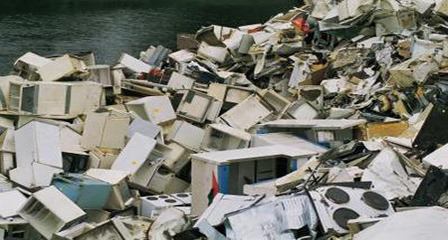
Proper disposal of old appliances is an important part of the process of energy-efficient upgrades. Many retailers take away old appliances when delivering new ones, with the cost being built into the purchase price. City municipalities offer 12,000 appliance recycling programs nationwide. Private companies collect and properly dispose of some home appliances. []

Marine Pollution

The oceans are so vast and deep that until fairly recently, it was widely assumed that no matter how much trash and chemicals humans dumped into them, the effects would be negligible. Proponents of dumping in the oceans even had a catchphrase: "The solution to pollution is dilution."

Today, we need look no further than the New Jersey-size dead zone that forms each summer in the Mississippi River Delta, or the thousand-mile-wide swath of decomposing plastic in the northern Pacific Ocean to see that this "dilution" policy has helped place a once flourishing ocean ecosystem on the brink of collapse.

Pollution's Many Forms
There is evidence that the oceans have suffered at the hands of mankind for millennia, as far back as Roman times. But recent studies show that degradation, particularly of shoreline areas, has accelerated dramatically in the past three centuries as industrial discharge and runoff from farms and coastal cities has increased.

Pollution is the introduction of harmful contaminants that are outside the norm for a given ecosystem. Common man-made pollutants that reach the ocean include pesticides, herbicides, chemical fertilizers, detergents, oil, sewage, plastics, and other solids. Many of these pollutants collect at the ocean's depths, where they are consumed by small marine organisms and introduced into the global food chain. Scientists are even discovering that pharmaceuticals ingested by humans but not fully processed by our bodies are eventually ending up in the fish we eat.

Many ocean pollutants are released into the environment far upstream from coastlines. Nitrogen-rich fertilizers applied by farmers inland, for example, end up in local streams, rivers, and groundwater and are eventually deposited in estuaries, bays, and deltas. These excess nutrients can spawn massive blooms of algae that rob the water of oxygen, leaving areas where little or no marine life can exist. Scientists have counted some 400 such dead zones around the world.

Solid waste like bags, foam, and other items dumped into the oceans from land or by ships at sea are frequently consumed, with often fatal effects, by marine mammals, fish, and birds that mistake it for food. Discarded fishing nets drift for years, ensnaring fish and mammals. In certain regions, ocean currents corral trillions of decomposing plastic items and other trash into gigantic, swirling garbage patches. One in the North Pacific, known as the Pacific Trash Vortex, is estimated to be the size of Texas. A new, massive patch was discovered in the Atlantic Ocean in early 2010. 

Noise Pollution
Pollution is not always physical. In large bodies of water, sound waves can carry undiminished for miles. The increased presence of loud or persistent sounds from ships, sonar devices, oil rigs, and even from natural sources like earthquakes can disrupt the migration, communication, hunting, and reproduction patterns of many marine animals, particularly aquatic mammals like whales and dolphins.

End of the "Dilution" Era
Humans are beginning to see the shortsightedness of the "dilution" philosophy. Many national laws as well as international protocols now forbid dumping of harmful materials into the ocean, although enforcement can often be spotty. Marine sanctuaries are being created to maintain pristine ocean ecosystems. And isolated efforts to restore estuaries and bays have met with some success.

Share

Twitter Delicious Facebook Digg Stumbleupon Favorites